There is a romanticized image of the band — five people crammed into a van, passing riffs around, finishing each other’s musical sentences. It is a beautiful idea. It is also, for most serious musicians, a fantasy that collapses the moment real life shows up. Data from Songkick tracking 7,000 bands over three years found that fewer than half even played a second show. That reality is exactly why FORM operates as an independent music producer — working alone. Not out of necessity. Out of intention.
| What You’ll Learn | The Short Version |
|---|---|
| Why bands fail so often | Scheduling, egos, creative conflict, and life derail most groups before they finish anything |
| What an independent music producer actually does | Everything: composition, instrumentation, mixing, mastering, marketing |
| Why solo does not mean small | Pro-level tools have leveled the playing field completely |
| The real advantage of one vision | No committee. No compromise. Every decision serves the music |
| What FORM is building | A consistent, growing catalog made with full creative control at every stage |
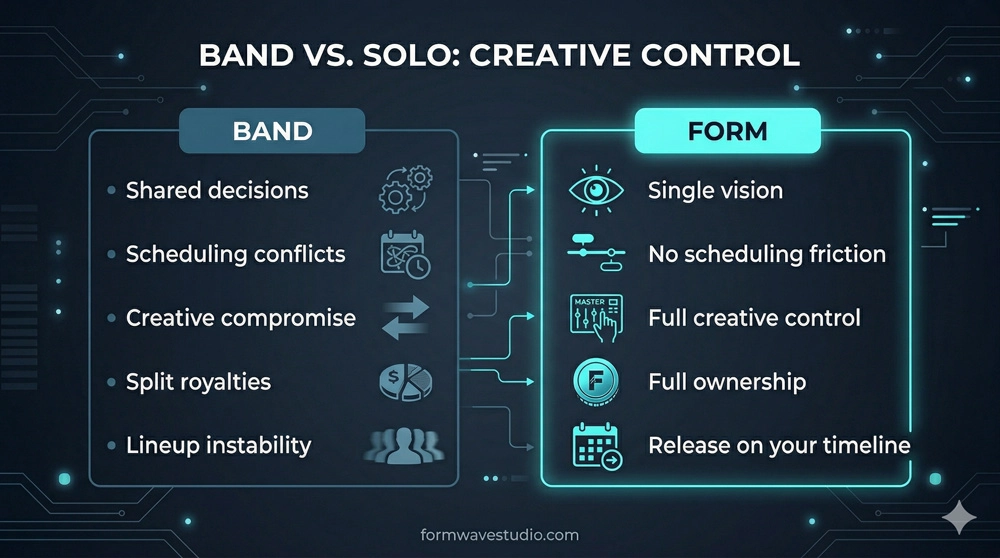
To have a functioning band, you need multiple people with the same vision, the same availability, the same work ethic, and the same tolerance for the grind — at the same time. You need everyone to show up to rehearsal. You need egos that do not eat the room. You need a group that holds together long enough to actually finish something.
That is not a band. That is a miracle.
Bands break apart for a wide range of reasons: diverging musical visions, personality clashes, financial disputes, conflicts with management, and the physical and mental toll of constant touring and recording. These are not rare stories. They are the norm. Countless ideas die in committee. A great hook gets softened because someone was uncomfortable with the direction. A release gets delayed because two members had a falling out. A band dissolves two weeks before a record drops.
When you are counting on four or five people to share your sense of urgency, your timeline, and your creative instincts, you are betting against the odds every single day.
FORM produces everything from scratch, independently. You can hear exactly what that looks like across the full FORM catalog on the Listen page.
The drums, the bass, the guitars, the keys, the arrangement, the mix, the master — all of it comes from one place. The artwork, the marketing copy, the release strategy — same. When a sound appears at 2am, there is no text thread to start, no session to schedule, no availability to check. The DAW opens and the work begins.
That is not a compromise. That is complete creative control.
Cold Arc is a clear example of this process in action — a project built entirely without outside input, from the initial composition through to the final release. Every decision, from texture to tempo, came from one set of hands. The result sounds exactly like it was supposed to sound, because nothing had to survive a group vote. Oleanderia follows the same process. Two distinct projects. One consistent vision. That kind of throughline is something a revolving cast of collaborators simply cannot produce.
The assumption people make is that one person means a smaller sound or a simpler product. That assumption is wrong.
Working as an independent music producer means access to the same tools used in professional studios. Over 9.5 million tracks were released by independent artists in a single year — eight times more than those released by major labels combined. The gap between a bedroom record and a commercial release is no longer about gear. It is about skill and taste, and those are developed through repetition and discipline over years.
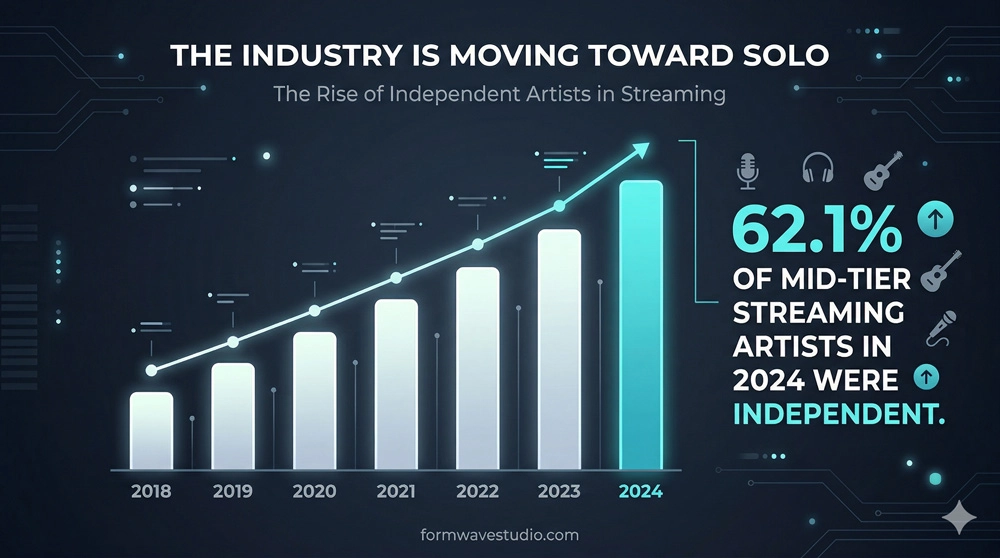
Independent artists made up 62.1% of all artists who accumulated between one million and ten million on-demand audio streams in the first half of 2024 alone. The model works. It works because listeners do not care about your headcount. They care about whether the music reaches them.
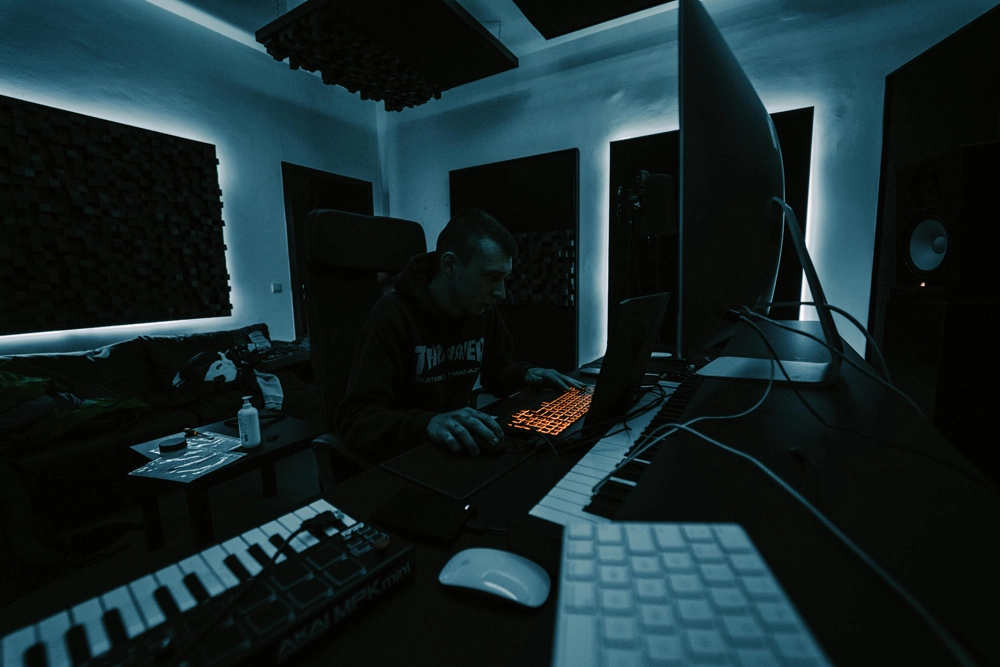
FORM is not just a music project. It is a fully operational creative operation. FORM Wave Studio is where the production work happens — a space built specifically for the kind of focused, uninterrupted work that group dynamics tend to disrupt.
If you are a songwriter or creative team looking to understand what a focused, professional production environment can do for your ideas, the Songwriting Sessions for Teams page is worth a look. The philosophy behind those sessions is the same one that drives every FORM release: an intentional process produces better results than collective improvisation.
Here is the reframe: a band is not a baseline. It is a resource. And like any resource, it is only valuable when it is available and aligned. Most of the time, it is not.
The musicians who have built lasting, meaningful catalogs did not wait for the right lineup. They built their sound on their own terms and brought collaborators in when it served the work — not out of structural necessity. That is the FORM model. Not anti-collaboration. Pro-intention.
Every element of a FORM release serves the piece. Nothing is there because someone needed a part to play. Nothing got watered down in a group vote. The music sounds exactly the way it is supposed to sound, because there is only one person deciding what that means.
If you have streamed a FORM track, picked something up from the shop, or shared anything from the catalog — you have experienced what one independent music producer with a clear vision can deliver. No arguments about the mix. No split decisions on direction. No waiting on anyone.
Just music, built from the ground up, exactly the way it was supposed to sound.
Stay current with everything happening at FORM News — new releases, project updates, and announcements land there first. Or reach out directly on the contact page if you want to connect.
The catalog is growing. Follow along.